


How Much Does It Cost to Build an Online Store in 2026?
If you are comparing the cost to build an online store, the biggest variables are the ecommerce platform, domain, hosting, design, development, payment processing, marketing, and ongoing maintenance. For a small business, a basic store can cost hundreds of dollars in the first year, while a custom ecommerce website can cost tens of thousands or more.
Let's cut straight to it you're here because you want to know what you'll actually pay. Not vague ranges. Not "it depends." Real numbers.
If you're still deciding how to build the site behind your store, see our website builder guide for a no-code approach to creating and managing a professional website.
I've broken down every cost category with actual dollar figures so you can budget properly before you start building.
How Much Does It Cost to Make an Online Store?
Here's the short answer:
Your Store TypeTotal First-Year CostDIY store with a platform like Webruno, Shopify, or Wix$400 – $1,500Mid-range store with custom design and more features$5,000 – $25,000Enterprise-level custom-built store$50,000 – $250,000+
Most small businesses fall into the first category. If you're just starting out, you can realistically launch for under $1,000 in your first year.
Online Store Cost Breakdown: Where Every Dollar Goes
Let me walk you through each cost so you're not blindsided later.
1. Domain Name: $12–$15 per year
Your domain is your store's address on the internet (like yourshop.com).
What you'll pay: Around $12–$15 annually through registrars like Namecheap or Google Domains. Premium domains can cost thousands, but you don't need that to start.
Money-saving tip: Many ecommerce platforms include a free domain for the first year when you sign up. Check before you buy separately.
2. Web Hosting: $0–$300 per year
Hosting keeps your store live. This is where a lot of new store owners get confused because costs vary wildly.
If you use an all-in-one platform like Webruno or Shopify: Hosting is included in your monthly plan. You pay nothing extra.
If you use WooCommerce (WordPress): Basic shared hosting runs $5–$15/month, so about $60–$180/year. As you grow, you might need better hosting at $30–$100/month.
If you go completely custom: Expect to pay $50–$500/month for enterprise-level hosting.
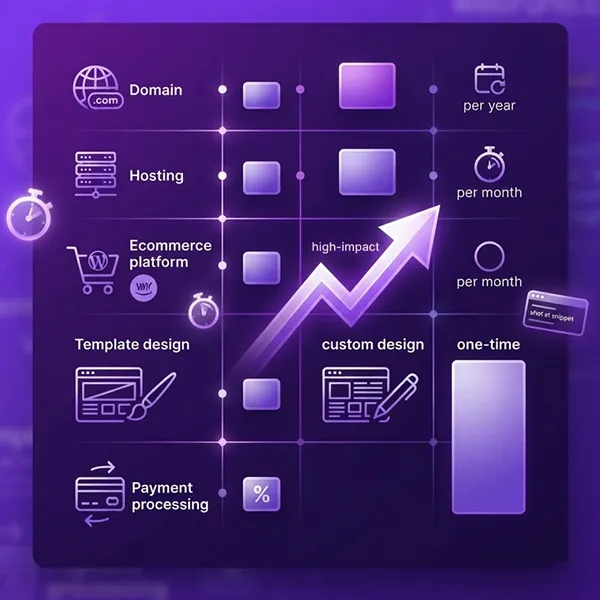
3. Ecommerce Platform: $29–$299/month
This is your store's foundation the software that lets you list products, accept payments, and manage orders.
All-in-one platforms (Webruno, Shopify, BigCommerce):
- Basic plan: $29–$39/month
- Mid-tier: $79–$105/month (necessary for most growing stores)
- Advanced: $299–$399/month
Open-source (WooCommerce, Magento Open Source):
- Software is free
- But you'll pay for hosting, security plugins, and other add-ons
- Realistically: $21–$100+/month depending on your needs
The math: First year on a basic all-in-one plan = roughly $350–$470.
4. Theme or Design: $0–$5,000+
How your store looks matters but how much you spend is completely up to you.
Option 1: Free theme
- $0
- Perfect for starting. Not the most unique, but functional.
Option 2: Premium theme
- $60–$200 (one-time)
- Better looking, more features, still affordable.
Option 3: Custom design from a professional
- $2,000–$10,000+
- A designer creates a unique look for your brand.
- You'll also need a developer to implement it.
Option 4: Fully custom build
- $15,000–$50,000+
- Everything built from scratch. Expensive but unlimited flexibility.
My take: Start with a premium theme ($60–$200). Upgrade to custom design once you have revenue.
5. Development / Custom Coding: $0–$25,000+
If you're using an all-in-one platform free website builder and a pre-built theme, you probably don't need a developer at all. The drag-and-drop builders handle everything.
If you need custom features not available out-of-the-box:
Development ScopeEstimated CostBasic customizations (CSS tweaks)$50–$200Advanced customizations (new features)$500–$5,000Full custom development$10,000–$25,000+
6. Payment Processing Fees: 2.9% + $0.30 per transaction
This is not a fixed monthly cost it scales with your sales. Every time you make a sale, you pay a fee to the payment processor.
Standard rates (Stripe, PayPal, Square):
- 2.9% + $0.30 per transaction
- Some in-person or high-volume plans can get it down to 2.6% + $0.10
Examples of what you'll actually pay:
- Sale of $50 → fee = $1.75
- Sale of $100 → fee = $3.20
- Sale of $1,000 → fee = $29.30
On-platform processing (Shopify Payments, Webruno Payments):
- Often lower rates for lower-tier plans
- Some platforms charge an extra transaction fee if you use a third-party gateway (e.g., Shopify charges an extra 0.5–2% if you don't use Shopify Payments)
Pro tip: Factor this into your pricing. If you sell $20,000 in your first year, expect to pay roughly **$580–$650** in transaction fees.
7. Product Photography & Content: $0–$2,000+
People buy with their eyes. Good product images sell. Bad ones don't.
OptionCostDIY with a smartphone (good lighting is key)$0Hire a product photographer$100–$1,000+ per sessionStock photos (if not selling physical products)$10–$100 for a pack3D renders or professional retouching$50–$200 per image
Real talk: Your phone can produce good enough images to start. Upgrade to professional photos after you've made your first sales.
8. SEO & Marketing: $0–$2,000+/month
This is where most of your long-term investment should go. A store without visitors is just a digital ghost town.
SEO (Search Engine Optimization):
- DIY with free tools: $0
- SEO tool subscriptions (Ahrefs, SEMrush): $100–$500/month
- Hiring an SEO specialist: $500–$5,000/month
Paid Ads (Google, Facebook, Instagram):
- Minimum budget: $5–$10/day = $150–$300/month
- Serious marketing budget: $500–$5,000+/month
Email marketing:
- Basic plan (up to 500 subscribers): $0–$15/month
- Growing list (5,000–10,000 subscribers): $30–$100/month
Content marketing:
- Blog posts, videos, social content
- DIY: $0 (your time)
- Hire a freelance writer: $50–$200 per post
My advice for new stores: Focus on SEO and organic social media first. It's free and builds long-term value. Add paid ads once you have a proven product.
9. Ongoing Maintenance: $0–$200/month
Your store needs regular upkeep even with an all-in-one platform.
All-in-one platforms: Maintenance is handled for you. $0 additional cost.
Self-hosted stores:
- Security plugins: $50–$200/year
- Performance optimization: $0–$100/month
- Backups: $0–$50/month
- Developer retainer for updates: $50–$200/month
10. Optional Add-ons & Plugins: $0–$500/year
Most platforms have app stores where you can add extra functionality.
CategoryTypical CostEmail marketing integration$10–$30/monthReviews & ratings$20–$50/monthAbandoned cart recovery$20–$60/monthInventory management$20–$100/monthLoyalty programs$20–$50/monthLive chat$0–$30/month
The trap: It's easy to add $100/month in apps without noticing. Start with free plans and add paid ones only when necessary.
Online Store Cost: 3 Real-World Scenarios
Scenario 1: Bootstrapped Solo Founder (First-Year Total: ~$800)
ExpenseCostDomain$15Platform subscription (basic)$350 ($29/mo)Theme (free)$0Development (DIY)$0Payment processing fees (on $10k sales)$300Photography (phone)$0Marketing (organic SEO + social)$0Maintenance (included)$0Add-ons$0TOTAL~$665
Scenario 2: Growing Brand with Some Budget (First-Year Total: ~$8,700)
ExpenseCostDomain$15Platform subscription (mid-tier)$950 ($79/mo)Premium theme$150Basic developer customizations$1,000Payment processing fees (on $80k sales)$2,500Professional product photography$1,000SEO specialist (monthly retainer)$2,500Email marketing (basic plan)$300Add-ons (reviews, live chat)$500TOTAL~$8,915
Scenario 3: Fully Custom Enterprise Store (First-Year Total: ~$70,000+)
ExpenseCostDomain$15Custom hosting$5,000Custom development$30,000Custom design$10,000Payment processing fees (on $500k sales)$15,000Premium photography/video$5,000Full-service marketing agency$24,000 ($2k/mo)Ongoing maintenance & support$6,000Add-ons & integrations$2,000TOTAL~$97,000
How Webruno Keeps Your Costs Low
Here's the thing about Webruno: it's built to be an all-in-one solution. That means you're not paying separately for:
- Hosting (included)
- A CRM (included)
- Email marketing tools (included)
- Analytics (included)
- SEO tools (included)
In many other setups, you'd pay for:
- Shopify or WooCommerce: $30–$100/month
- Separate CRM: $15–$100/month
- Email marketing software: $10–$50/month
- Hosting (if self-hosted): $10–$100/month
- Analytics & tracking tools: $0–$50/month
With Webruno, you get all of that bundled together. That could easily save you $50–$200+ per month compared to piecing together different services.
9 Practical Ways to Keep Costs Down
- Start with a free or premium theme. Don't pay for custom design until you have revenue to justify it.
- Use your phone for product photos. Good lighting and a clean background go a long way.
- Write your own product descriptions. No need to hire a copywriter for your first 10 products.
- Focus on SEO and organic traffic before paid ads. It takes longer but costs nothing.
- Use free versions of apps and plugins. Most have free tiers that are enough for early growth.
- Choose an all-in-one platform. You'll avoid paying for 5 separate subscriptions.
- Negotiate with freelancers. Especially for design and content work many are willing to work with startups.
- Start with a limited product catalog. Launch with 10–20 products, then expand as you learn.
- Plan for growth. Choose a scalable platform so you don't have to rebuild your website and pay again later.
Frequently Asked Questions About Online Store Costs
What's the absolute minimum I need to start?
If you're super lean:
- Domain: $15/year
- Basic platform subscription: $29/month
- Free theme: $0
- DIY everything else: $0
First-year minimum: ~$400
Why do some stores cost $50,000+?
Custom development, unique design, enterprise-level integrations, and high-volume infrastructure. Most businesses don't need this from day one.
Can I switch platforms later?
Yes but it's a pain. Moving products, customer data, and SEO rankings takes time and effort. Choose wisely from the start.
What's the biggest hidden cost?
Marketing. Hands down. You can build a beautiful store for $1,000, but if nobody visits, it's useless. Budget for traffic from day one.
Is Webruno cheaper than Shopify?
Pricing is similar for the core platform, but Webruno includes CRM and marketing tools that Shopify charges extra for. Over time, that adds up to significant savings.
Final Take
The cost to build an online store in 2026 can be as low as $400** for your first year. Most successful small businesses spend **$1,000–$5,000 in year one, with the bulk going toward marketing and products, not the software itself.
The smartest move is to start small, validate your products, and reinvest your profits into growth. Don't spend $10,000 on custom development for an unproven idea. Start lean with an all-in-one platform, learn what works, and scale from there.
If you're ready to get started, check out the Webruno Plans and see how an integrated solution can simplify your costs and operations from day one.