

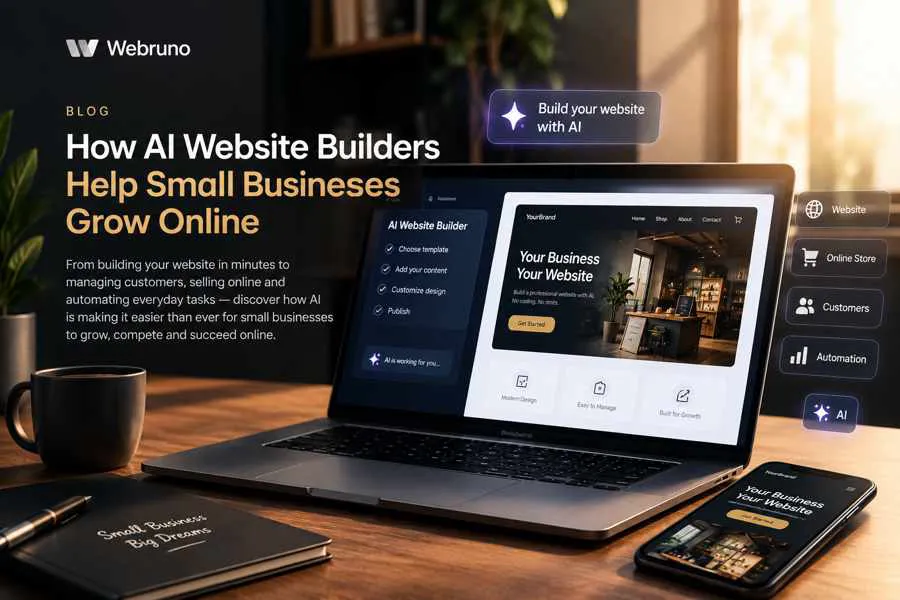
For a small business, building a website is no longer just about putting a few pages online. A modern business website needs to attract visitors, explain products or services, generate leads or sales, work well on mobile devices, support search engine optimization, and connect with the tools used to run the business. This is where an AI website builder can make the process easier.
AI can help turn a business idea into a useful starting point for a website, while connected business tools can help manage products, customers, orders, content, and repetitive workflows after the site goes live. The important shift is that AI is becoming part of the complete website-building process rather than being limited to writing a paragraph or generating an image.
What Is an AI Website Builder?
An AI website builder uses artificial intelligence to help with tasks that normally require manual planning and editing. Depending on the platform, AI can help create page structures, suggest website copy, organize sections, generate content ideas, recommend layouts, and assist with SEO.
The goal is not to remove the business owner from the process. Instead, AI provides a strong starting point so the owner can spend more time reviewing the business message, products, brand, and customer experience.
Why Small Businesses Are Turning to AI Website Builders
Small businesses often have limited time and technical resources. A business owner may need to handle sales, customer support, inventory, marketing, accounting, and operations while also trying to build an online presence. Learning several complicated software systems can become a significant burden.
An AI-assisted website builder can reduce some of this initial complexity. Instead of starting with a blank page, the business owner can describe the company, target customers, services, products, and goals. AI can then help create an initial structure that the owner can edit and improve.
1. Build a Website Faster
One of the clearest benefits of AI is reducing the time needed to create the first version of a website. A business can provide information about what it sells, who it serves, and what visitors should do. AI can use that context to suggest pages such as Home, About, Services, Products, Contact, and FAQ.
This does not mean a website should be published without review. The first version should be treated as a starting point. Business-specific information, pricing, policies, images, contact details, and claims should always be checked before publication.
2. Create Better Website Content
Writing website content can be one of the slowest parts of launching a new site. Businesses may need service descriptions, product copy, FAQs, landing pages, calls to action, and educational articles.
AI can create initial drafts based on information supplied by the business. It can also rewrite content for clarity, create different versions of a headline, turn product specifications into readable descriptions, and identify questions that customers may have.
The best approach is to use AI for acceleration while keeping human review in the publishing process. Accurate, original, useful information is more valuable than generic text created only to fill a page.
3. Use AI Without Ignoring SEO
An AI website builder does not automatically make a website rank in Google. Search visibility still depends on factors such as search intent, useful content, technical accessibility, site structure, internal linking, page speed, mobile usability, and the overall quality and relevance of the website.
AI can support SEO by helping identify related topics, create content outlines, improve page organization, suggest title ideas, and prepare initial metadata. Businesses can also use a dedicated SEO-friendly website builder approach to make sure important technical and on-page elements are manageable.
For a deeper look at the subject, see our guide to website builder SEO.
4. Turn a Website Into an Online Store
Many small businesses eventually need more than informational pages. They need to display products, accept orders, manage inventory, process payments, and keep customer information organized.
An AI-assisted platform can make the starting process simpler, while ecommerce tools provide the operational layer behind the website. Webruno's online store builder is designed to combine website creation with products, orders, inventory, payments, and SEO.
This connection matters because a store is not simply a collection of product pages. The business also needs a reliable process for managing what happens before and after a customer places an order.
5. Connect Customers, Orders, and Business Data
When a customer contacts a business, visits a product page, places an order, or returns for another purchase, useful information is created. If that information is spread across unrelated systems, it can become difficult to understand the complete customer journey.
A connected platform can keep customer records, orders, products, and website activity closer together. This can reduce repetitive data entry and make everyday operations easier to manage.
6. Automate Repetitive Tasks
Automation is one of the most practical applications of AI and modern business software. A business may repeatedly send order updates, follow up with leads, notify customers, update internal records, or perform other routine actions.
Not every workflow should be automated. The right approach is to identify repetitive tasks with clear rules and automate those first. AI can then assist with tasks that require understanding text, summarizing information, generating responses, or categorizing requests.
7. Improve the Customer Experience
A website should make it easy for visitors to understand what a business offers and what they should do next. AI can help identify common customer questions and support useful answers, recommendations, and content.
For example, an online store may receive repeated questions about delivery, payment methods, product specifications, or returns. Clear website content and AI-assisted support can reduce unnecessary friction while allowing complex requests to reach a human member of the business.
AI Website Builder vs. Traditional Website Building
Traditional website development can provide extensive control and customization, but it may require more technical knowledge, planning, and coordination. An AI website builder focuses on reducing the work required to get from an idea to a usable starting point.
Neither approach eliminates the need for strategy. A business still needs to understand its customers, define its offer, create accurate content, choose appropriate products or services, and maintain the website after launch.
The difference is that AI can handle more of the repetitive preparation work, allowing the business owner to focus on decisions that require real business context.
How to Use AI to Build a Business Website
A practical process can be divided into several steps:
- Define the business: Explain what the company sells, who it serves, and what makes the offer useful.
- Define the goal: Decide whether the website should generate leads, sell products, receive bookings, provide information, or support an existing business.
- Create the structure: Use AI to suggest the most useful pages and sections for the audience.
- Add real business information: Replace generic suggestions with accurate products, services, prices, policies, contact details, and brand information.
- Optimize for search: Create useful pages around genuine customer questions and maintain logical URLs, titles, descriptions, headings, and internal links.
- Connect business tools: Add products, orders, customers, payments, inventory, or other tools when the business needs them.
- Automate repetitive work: Start with simple workflows that have clear triggers and predictable outcomes.
- Measure and improve: Use analytics and customer feedback to identify pages and workflows that need improvement.
What AI Should Not Replace
AI can accelerate website creation, but it should not replace business judgment. A company should verify every important claim, product specification, price, policy, and customer-facing instruction before publishing it.
AI-generated content can also become repetitive when businesses publish large amounts of generic material without adding original information. The objective should be to create genuinely useful pages for customers, not simply produce more words.
Brand positioning also requires human judgment. AI can suggest ideas, but the business owner understands the company's customers, reputation, products, and competitive environment better than a generic system.
Why an Integrated Platform Matters
Website creation is only the beginning of an online business. After launch, the company may need ecommerce, customer management, order processing, inventory, SEO, and automation.
Using separate tools for every function can create additional costs and maintenance. It can also make it harder to keep information synchronized. An integrated platform can bring more of these workflows into one environment.
Webruno is built around this model. Businesses can create a website, build an online store, manage products and orders, organize customers, work on SEO, and connect business workflows from the same platform.
How Webruno Uses the AI Website Builder Approach
Webruno combines visual website building with tools designed for online business operations. A business can start by creating its website and then expand into ecommerce, customer management, orders, inventory, SEO, and automation as its needs grow.
For businesses that want a faster starting point, Webruno can be used as a foundation for creating a professional online presence without requiring the business owner to build every component from scratch.
If you are starting with a simple business website, you can explore the Webruno website builder. If the main goal is ecommerce, the online store builder provides a more focused starting point.
The Future of AI Website Building
The next generation of website builders is likely to move beyond page creation. Instead of asking only how to design a homepage, businesses will expect software to help with the complete online workflow: attracting visitors, presenting products, collecting leads, managing customers, processing orders, answering questions, and automating repetitive tasks.
In that model, the website becomes the public-facing part of a larger digital business system. AI helps with the work around it, while the business owner remains in control of strategy and important decisions.
Final Thoughts
An AI website builder can make launching a small-business website faster and more accessible, but the real opportunity is larger than website design. AI can help businesses create content, organize information, support SEO, improve customer communication, and automate repetitive work.
The strongest approach is not to automate everything. Start with a clear business goal, create useful content, make the customer journey simple, connect the tools that matter, and automate repetitive tasks when there is a clear benefit.
For small businesses, that combination can turn a basic website into a practical system for attracting customers, selling online, managing relationships, and growing over time.