

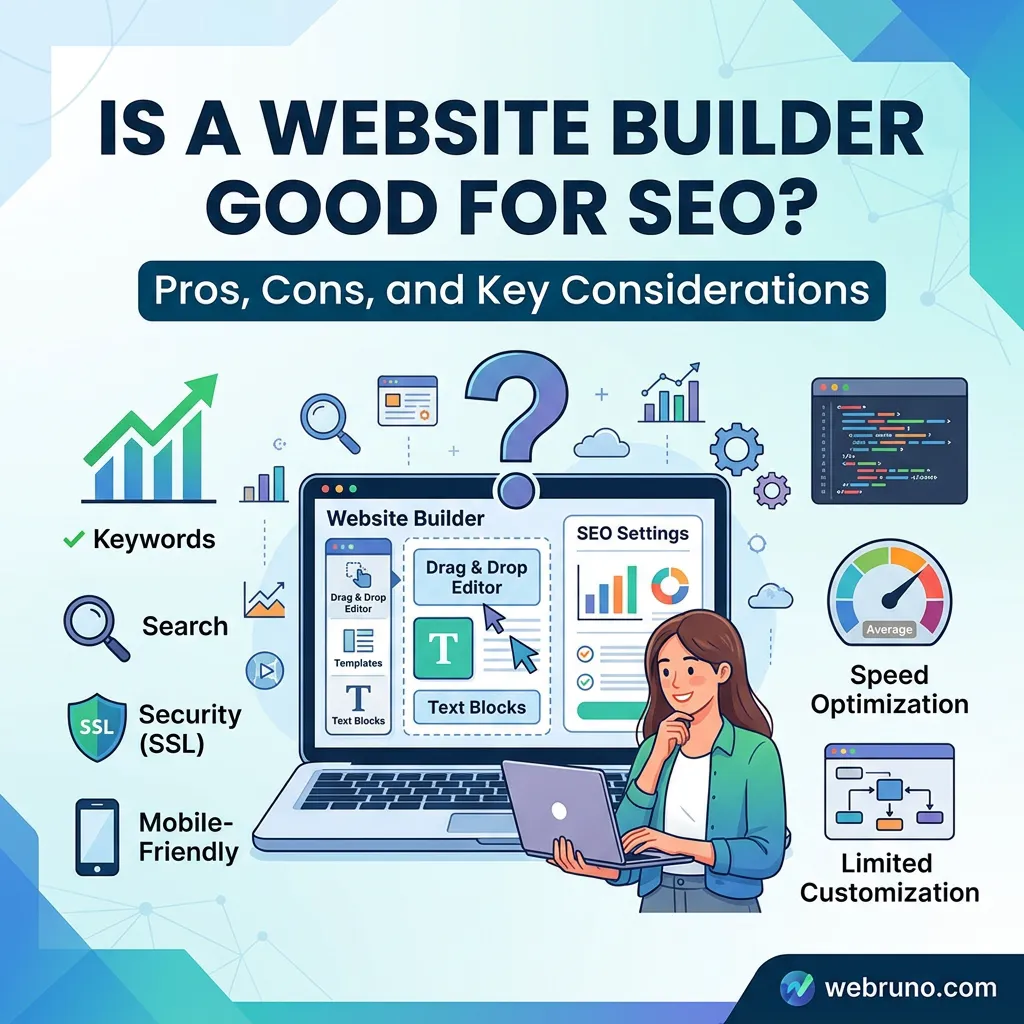
Is a Website Builder Good for SEO? A Straight Answer, Backed by Facts
It's one of the most common questions business owners ask before they even pick a platform: will a website builder actually hold up in search results, or will it quietly cap how far my site can grow? Some people swear builders are fine. Others insist you need custom code to rank at all. The truth sits somewhere more nuanced than either camp admits.
In this article, we'll walk through exactly how website builders perform across on-page SEO, technical SEO, site speed, URL structure, schema, and Google indexing — and where the real limits actually show up.
What a Website Builder Is, in Plain Terms
A website builder is a platform that lets you create a site without writing code — you pick a template, add your content, and publish. Wix, Squarespace, and Shopify are the names most people know. These platforms typically take care of hosting, security, infrastructure, and updates on their end, so all you're really doing is building and publishing.
The real question isn't whether that's convenient — it obviously is. It's whether that convenience comes at the cost of how well your site can actually rank.
What SEO Actually Depends On
Before judging whether a builder is "good" for SEO, it helps to know what SEO is actually built on: a sensible URL structure, fast loading times, clean code, editable meta tags, proper heading hierarchy, structured data (schema), optimized images, mobile responsiveness, control over your robots.txt file, and the ability to connect to Google Search Console. With that checklist in mind, here's how builders actually measure up in each area.
URL Structure
Most modern builders let you edit your URLs, though some still lock parts of the structure in place or limit how categories are organized. For a small site, this rarely matters. For a large one with thousands of pages, it can start to feel restrictive.
Site Speed
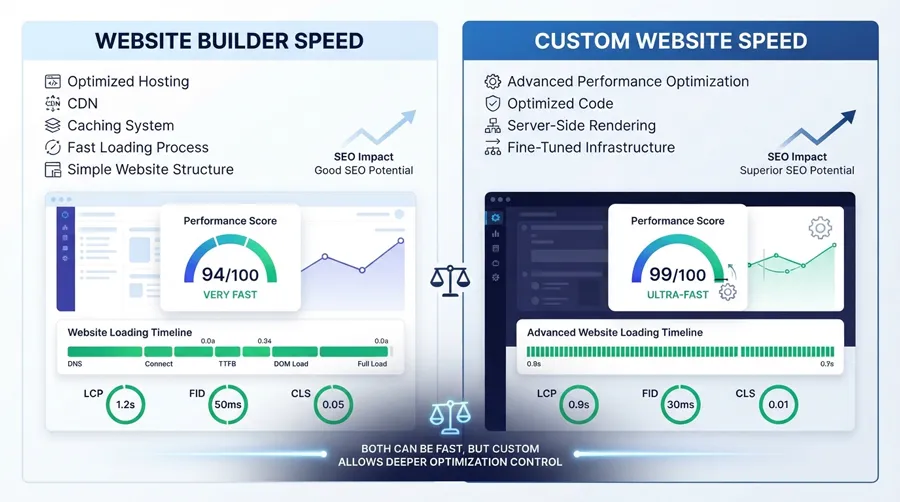
Speed is one of Google's clearest ranking signals, and builders have a mixed record here. On the plus side, most run on optimized servers with a built-in CDN and automatic caching. On the downside, template code tends to carry extra weight, and you don't get access to the kind of deep, page-by-page optimization a custom build allows. In genuinely competitive markets, a professionally optimized custom site can out-perform a builder on raw speed. For most small and mid-sized businesses, though, builder speed is more than good enough — especially when the platform itself is built with how site builders and SEO actually work together in mind from the start.
On-Page SEO
This is where most builders genuinely hold their own. You can set meta titles, write meta descriptions, add alt text to images, edit headings, and add internal links without any real restriction. There's no meaningful gap here between a builder and a custom build.
Technical SEO
This is where the real difference shows up. Custom sites let you configure server structure, set up complex redirects, implement custom schema, and dig into server logs directly. Builders are more limited on all of these fronts. If you're operating in a fiercely competitive niche — insurance, crypto, travel — that ceiling can genuinely hold you back, and it's worth reading a full comparison between builders and WordPress to see how much of that gap actually applies to your situation.
Google Indexing
Here's some good news: Google indexes builder-based sites exactly the same as custom ones. There's no built-in penalty for using a builder. What actually matters is valuable content, a sound site structure, decent speed, and real link building — not which tool you used to publish. A good illustration of this is a real case study on cutting site search time, where the platform itself wasn't the bottleneck at all.
Schema and Structured Data
Many builders allow custom code in the page header, which opens the door to things like product schema, FAQ schema, and article schema. That said, this feature is sometimes locked behind cheaper plans, so it's worth checking before you commit to a subscription.
Content and Blogging
SEO without content doesn't really go anywhere, and most builders handle this fine — blog creation, article categories, tags, and per-post meta settings are usually all supported. That's enough for a solid, ongoing content strategy, and it's a big part of why where web design trends are heading in 2026 puts so much weight on content-driven growth rather than raw code.
Is a Builder Enough for a Competitive Market?
It genuinely depends on what you're competing for. If you're running a local store, offering regional services, working in a less crowded market, or operating on a tight budget, a builder is completely sufficient — and honestly the more practical choice. But if you're chasing national keywords, running a large-scale startup, need deep technical SEO control, or plan to index thousands of pages, a custom build starts to make more sense. If your business is somewhere in between, it's worth reading through this look at how website design choices shape SEO outcomes before deciding either way.
The Old Myth About Builders and SEO
There's a belief that's stuck around longer than it should have: that website builders are simply bad for SEO. That was closer to true years ago, when early platforms had real technical shortcomings. Modern builders have closed most of that gap. The honest way to frame it today isn't "can a builder rank" — it's "where's the growth ceiling," which is a very different question.
When a Builder Makes Sense
A builder is the right call if you're running a small business, focused mainly on local search, working with a limited budget, don't have a technical team, and aren't planning anything especially complex. In that situation, tools built around search optimization strategies for online stores can get you live and ranking without unnecessary overhead.
When Custom Development Makes Sense
Custom design earns its cost when you're running a large, scalable project, need full control over technical SEO, are competing nationally or internationally, or need deep customization a template simply can't offer.
So, Is a Website Builder Good for SEO?
Yes — for most businesses, it genuinely is. If you're small to medium-sized and growing at a reasonable pace, a builder can meet your SEO needs without friction. If you're aiming at serious, high-stakes competition, custom development or a more advanced platform becomes the better fit.
Either way, SEO was never really about the tool alone. Content strategy, content quality, real link building, user experience, site speed, and ongoing data analysis matter more than the platform underneath them — a point backed up well in this piece on how a website measurably affects overall sales. The tool matters. The strategy behind it matters more.