

Website Builder vs. Custom Web Design: Which Is Actually Right for Your Business?
Choosing between a website builder and a fully custom-coded site is one of those decisions that quietly shapes everything that comes after it. Get it right and your business grows into the platform smoothly. Get it wrong and you end up rebuilding from scratch a year or two in — usually at a much higher cost than if you'd planned ahead.
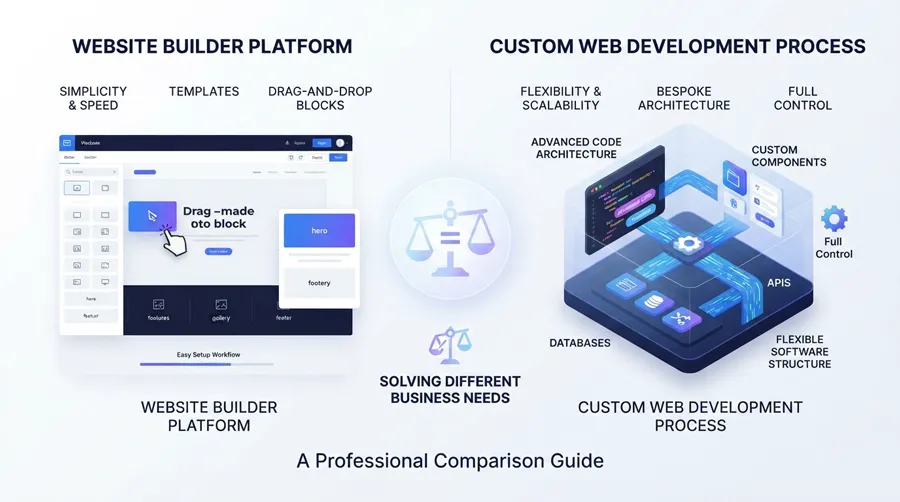
There's no universal winner here. Website builders win on speed and price for simple projects, while custom development wins on flexibility, performance, and long-term ownership for businesses planning serious growth. This guide walks through the real differences so you can make the call with your eyes open.
What a Website Builder Actually Is
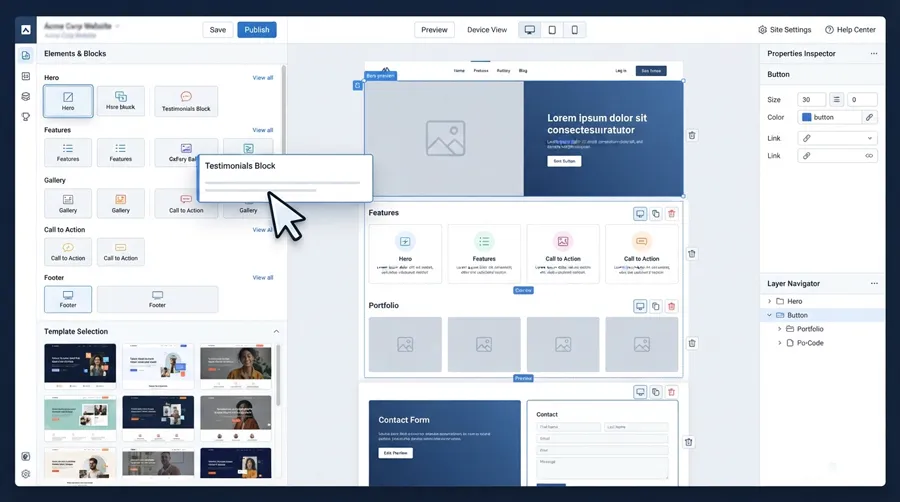
A website builder is a platform that lets you put a site together visually — dragging in sections, swapping templates, adding content — without touching a line of code. Wix, Squarespace, and Shopify are the names most people recognize in this space.
The provider handles the unglamorous parts for you: hosting, security patches, server infrastructure, uptime. You pay a subscription, and in exchange you get a finished, working site without needing a developer on staff.
What Custom Web Design Actually Means
Custom design is the opposite approach — your site is built from the ground up around your specific business, usually with something like Node.js, PHP, or Python on the backend and React or Next.js on the front end.
With this route, nothing is templated. The look is unique to you, the database is structured around your actual data, any feature you can imagine can be built, and you're never boxed in by what a third-party platform happens to allow.
Comparing the Two, Category by Category
Setup Cost
A builder gets you moving with a low upfront cost and a predictable monthly or yearly fee — no development team required. It's the more affordable option in the short run, especially for a small business just getting off the ground. Custom design costs more upfront, since you're paying for a developer or an agency plus ongoing maintenance, but over a long enough timeline it can actually work out cheaper, since you're not stuck renewing subscriptions forever. If budget is the deciding factor for you, it's worth reading through this breakdown of what it really costs to build an online store before committing either way.
Launch Speed
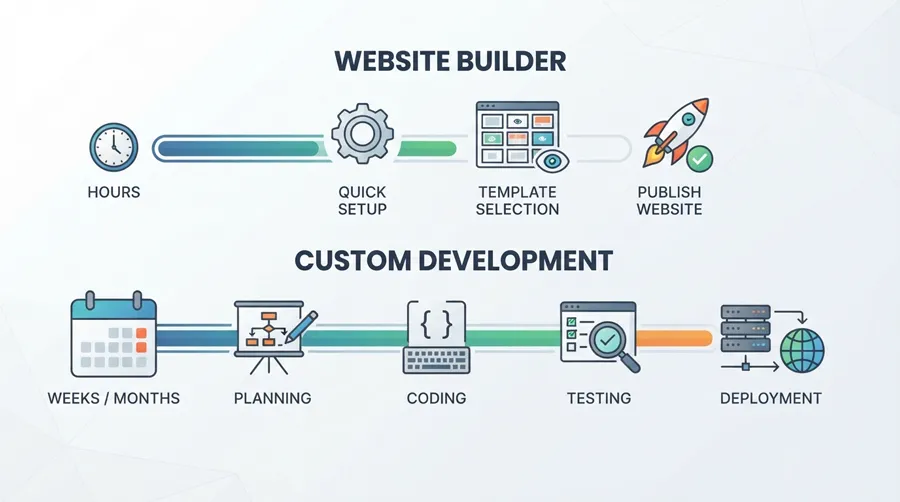
This one isn't close. A builder can have your site live within hours — pick a template, drop in your content, publish. Custom builds take weeks to months depending on complexity. If speed matters more than anything else right now, a builder wins outright.
Flexibility and Scalability
This is where the real gap opens up. Builders keep you inside the platform's defined feature set — code access is limited, and if you need something specific like a custom CRM connection, a complex pricing engine, or a bespoke API integration, you'll likely hit a wall. Custom design has no such ceiling: it's built around what your business actually needs, it can connect to any external service, and it supports fully custom admin tools. For anyone planning to scale seriously, custom development has the clear edge here.
SEO
Search visibility is often the single biggest growth lever a business has, and the two approaches handle it very differently. Builders come with basic SEO tools baked in, but they limit how deep you can go on technical optimization, and you have little control over server-level performance. Custom builds give you full control over URL structure, Core Web Vitals, server-side rendering, and precise handling of schema markup — the kind of technical depth that matters in competitive niches. This guide on whether a website builder is actually good for SEO digs into exactly where that platform ceiling tends to show up.
Security
With a builder, security is the provider's job — less technical risk lands on you, but you're also trusting someone else's infrastructure completely. With custom design, security depends entirely on whoever built the site: done properly, it can be considerably more secure than a generic template; done poorly, it can be worse. It's a trade of convenience for control.
Ownership and Independence
This is the part people tend to underestimate until it actually matters. On a builder, you don't fully own your setup — migrating away later is often expensive and messy, and if the platform changes its pricing or policies, you're along for the ride. With custom design, you own the code and the database outright, you can move to any server whenever you want, and no external company can dictate the terms of your own website.
Room to Grow
Builders handle small stores well but tend to strain once traffic or complexity climbs. Custom builds can scale across cloud infrastructure, plug into a CDN, and have their databases tuned for heavy load — which is why most large, fast-growing platforms end up here eventually.
When a Website Builder Is the Right Call
A builder makes the most sense if you're running a small local business, want a simple brochure-style site, are working with a tight budget, don't have technical staff on hand, or aren't planning anything particularly complex in the near future. If that's you, a free website builder is a genuinely reasonable place to start rather than overbuilding for a stage you're not at yet.
When Custom Design Is Worth the Investment
Custom development earns its cost when you're running a tech startup, managing a large product catalog, competing seriously on SEO, preparing to raise investment, or need real systems like CRM tooling and marketing automation built into the site itself. If integrating a CRM is part of that plan, this complete guide to CRM and website integration is a useful next read.
If your website is essentially a digital business card, a builder does the job fine. But if the website is meant to be the actual engine behind your sales and growth, custom design stops being a cost and starts being an investment. A lot of businesses learn this the hard way — they launch on a builder, outgrow it within a year or two, and end up paying more to migrate than they would have paid to build correctly from day one. Planning that path out in advance, the way this guide to the web design process from idea to launch lays out, tends to save both time and money later.
Making the Actual Decision
In the end, the choice comes down to three things: your budget, your long-term goals, and how fast you realistically expect to grow. A builder is the smart move for a quick, affordable start. Custom design is the stronger foundation if you're building something meant to last and scale.
If you're still weighing the two, it's worth looking at what a middle path looks like — a platform built to launch fast like a builder but with the room to grow like a custom build. You can see how that's structured on Webruno's plans page before deciding which direction fits your business best.